
PPWR & EPR Are Not Compliance Challenges. They Are the Next Competitive Advantage

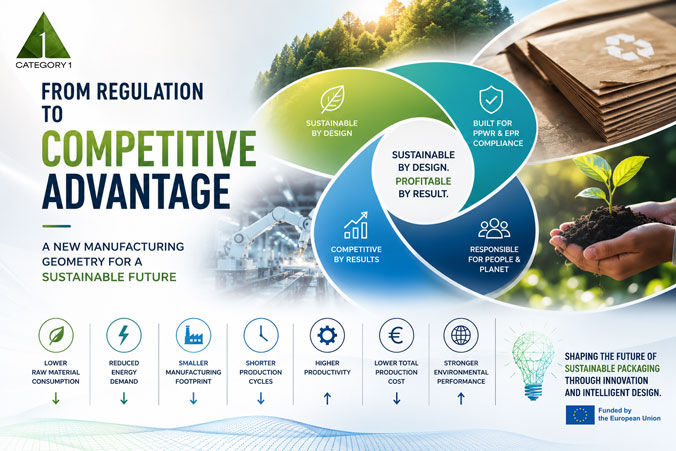
Most of the manufacturers, PPWR and EPR are viewed as regulatory obligations that increase costs and reduce margins.
We at CATEGORY 1 see them differently.
Our patented manufacturing innovation transforms PPWR and EPR from compliance requirements into a source of competitive advantage.
Rather than improving existing disposable paper containers through incremental material changes, we redesigned the manufacturing architecture itself. This distinction is critical because THE GREATEST INEFFICIENCIES IN DISPOSABLE PAPER PACKAGING ORIGINATE NOT FROM THE MATERIALS, BUT FROM THE WAY THE PRODUCTS ARE MANUFACTURED.
By addressing the manufacturing geometry at its source, we developed an entirely new disposable paper container production methodology that aligns naturally with the objectives of PPWR and Extended Producer Responsibility.
The result is beyond a new design.
It is a new industrial engineering framework for manufacturing disposable paper containers.
During the development of this patented innovation, we analyzed every major cost driver embedded within conventional manufacturing systems.
Many had become accepted as unavoidable simply because they were part of the industry's legacy production model.
Instead of accepting those constraints, we eliminated unnecessary manufacturing steps, simplified production architecture, and optimized the remaining processes.
The outcome delivers substantial improvements across the factors that matter most:
Lower raw material consumption
Reduced energy demand
Smaller manufacturing footprint Shorter production cycles
Higher manufacturing productivity
Stronger environmental performance
Lower total production cost by more than 30 – 40 %
This is precisely the direction envisioned by the European Union when introducing PPWR and Department of Environment in UK introducing EPR—not incremental product modifications, but innovations capable of fundamentally improving how packaging is manufactured.
Our technology was granted a patent in France because it represents more than a new disposable paper container.
It introduces a new manufacturing methodology designed for the next generation of sustainable packaging.
The future of sustainable packaging will not be defined solely by recyclable materials.
It will be defined by sustainable manufacturing geometry.
Manufacturers that recognize this shift early will discover that PPWR and EPR are not regulatory costs to manage—they are strategic opportunities to improve profitability, strengthen market position, and create lasting competitive differentiation.


